



I received a message today from a reader suggesting a particular website. I read the information on that particular website, and there was presented a hybrid energy producing system by using the waves as a “catalyst” for the operation of a diesel-powered generator.
In short, their inventions’ descriptions are these:
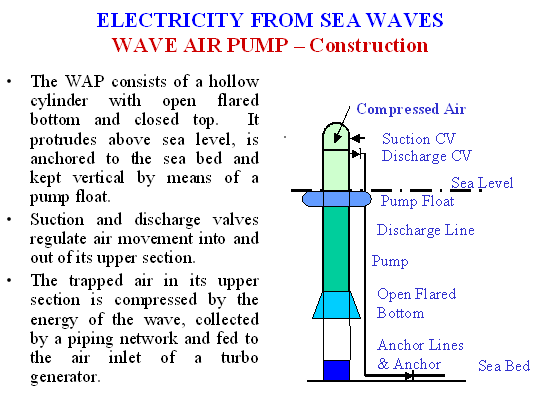
“1. Wave Air Pump – WAP:
Compresses air and feeds it into the air inlet of a turbo generator, inject fuel as needed to maintain a turbo generator output irrespective of wave heights.
2. Wind Turbine Pump – WTP
A wind turbine directly drives an air compressor, collects the compressed air in a piping network and feeds it to the air inlet of a turbo generator.

3. Wave Water Pump – WWP:
Lifts a small quantity of water to a high head and feed it to a hydro-turbo generator to produce power, or compressed air to feed another turbo generator and act as a WAP. A set of pumps or a set of wind turbines, up to ten and a mile wide or as needed may be installed in line with the incoming waves or wind to extract most of its energy. The proposed systems can generate dependable electric power at competitive cost.”
Their idea of an energy-producing system (by the way, energy cannot be produced nor be lost – it can only be converted) is very fruitful, because it has both the power of sun, wind, water and… the diesel. And that’s the worst part. The diesel comes from fossil fuels, has very harmful noxes and produces a lot of CO2. As someone said in a recent comment from gas2.0, “you don’t need to dance around the elephant in the room anymore!”. Wave power, if used, has to be self-sufficient, there must not be any other fuel-powered systems, and when I say that I mean internal combustion engines.
Update: I got a comment from the inventor of these WAP and WWP systems, and it seems I got things a little bit confused. He clarified them for me here.


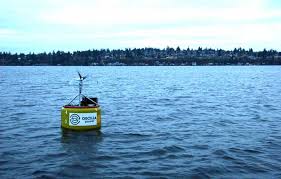





The story of diesel from sea waves resulted many comments.
Below is an update of the system.
SUMMARY
Once it is planned to extract offshore energy, then it is wise to explore all available offshore renewable energies and devise a system for maximum energy extraction and utilization of the respective sea surface area.
This leads to installing a Coordinated Offshore Energy Extraction system as shown in Figure-8 to extract energy from the following offshore renewable energy sources:
I. Wave Energy Extraction where Potential and Kinetic energies are extracted.
a. Potential Energy is extracted using Buoyant Floats to directly drive fluid pumps or electric generators.
b. Kinetic Energy is extracted using water turbines installed below lowest instantaneous sea level at the wave Lee Side to directly drive fluid pumps or electric generators to extract energy from the Lee side of the wave.
c. The small quantity of fluid at high head is collected and fed into a Closed Circuit turbo generator.
d. The electric power generated by the Closed Circuit turbo generators is 3-phase AC using variable speed Isosync. Generators; connected in parallel and fed to an offshore step up transformer for power transmission to the shore.
II. Tidal Energy is extracted by means of water turbines driving a fluid pump or electric generator.
III. Wind Energy using medium size wind turbines (1.5MW), and transferring the torque from the Nacelle at the top of the WT support to the electric generator installed at a dry deck. Suitable for Offshore and Land installation.
IV. Solar Energy using the roof of the offshore “Construction Unit” to install PV cells where DC current is generated and fed to a common bus and inverted to AC voltage and fed to a step up transformer.
V. Deep Sea Cold Water for use as Air Conditioning medium (SWAC). Injecting compressed air into the top section of a deep water pipe develops a positive head at the cold water intake at 800m below MSL and forces the cold water up the pipe where it is de-aerated and pumped as cold water to Air Handling Units.
VI. A “Construction Unit” fixed and anchored to the sea bed provides a dry deck and enclosed space for all equipment needed for the COEE system.
To Mr. Ovidiu
I wanted to differeciate between two types of turbo-generators;
1. Feeding high temperature steam (inherently high pressure steam) into a turbine to turn a generator to produce electricty.
2. Using a turbo Compressor to suck air at Standard Temperature and Pressure, compress it into a combustion chamber where fuel is injected and raises the tempreature of the air and consequently the pressure. This high pressure, high temperature air is directed into another turbine to turn a generator where electricity is produced.
The turbo compressor consumes energy to compress the air. In the proposed system the Wave Air Pump provides the compressed air from a renewable energy source, wave or wind. Therefore, the fueled turbo generator uses less fuel to generate the same amount of electric power.
All renewable energy sytems, have the dilema: if NO renewable enrgy source is available, there is no power output. In the proposed WAP and WTP sytems, Renewable energy source is available, the systems provides the required power at less fuel consumption, and when there is no renewable enrgy source, it operates at normal fuel consumption. This provides dependable power irrespective of availability of renewable energy source.
The main idea is to differentiate between the above two types. Details are at http://www.renewableenergypumps.com
Hope the above explains the misunderstanding.
Thanks for your interest, and thanks for including me at your site.
Hello mr. Shamil, Please tell me what I should understand from “The pump converts the kinetic energy of a wave into compressed air, collects it and feeds it to the air inlet of a fueled turbo generator.”? Doesn’t your system also use fuel (probably diesel) to generate electricity? If you are explicit enough, and make me understand what is the air inlet of a turbo generator and what is the “air inlet of a fueled turbine” I will rewrite the article gladly, and ask all my possible apologies for the mistake I made. If you don’t use any FUEL, please don’t mention this word, because in lay meaning, FUEL = petrol based fuel.
Thank you,
Ovidiu.
I don’t know what you are talking about.
Shamil Ayntrazi
Your comment about the renewable energy systems WWP and WAP is simply out of line it is a misrepresentation.
You are requested to correct your comments, otherwise kindly remove any reference to my systems and site.
Thanks for including the WWP and WAP systems at your site.
I am the inventor of these systems, Wave Water Pump and wave Air Pump. Both systems extract energy, WWP lifts a small amount of water to a much higher head, while WAP compresses air up to 100 psi, using the wave potential and wave kinetic energy.
There is no mention of producing diesel fuel.
Good post, I like your writing style! I’ve added http://greenoptimistic.com/ to my feed reader, and will be reading your posts from now on. Just a quick question – did you design your header image yourself, or have it done professionally? If you had it done by a professional, who was it?
Hi,
I designed the header image myself…
Ovi.
Tell me more, What a great idea and very informative, I am a huge diesel fan and wish everyone would support the cause…
Nice idea to generate diesel.very interesting to read.